1
Load the curriculum facts before ads go live
Module map, beginner fit, access terms, price FAQ, refund language, and phrases you never want in public. Share one source of truth with everyone who will touch the thread.

Launch week floods, curriculum questions, and competitor bait: how course and coaching ads stay useful without looking unmanaged.
5 min read · Published Aug 10, 2026
The vertical
When someone comments “is module 3 actually about Facebook ads, or just a mention?” under a course launch creative, that is not noise. It is a buyer comparing you to two other programs before they pay. Leave it unanswered and they scroll on. Answer it vaguely and they trust you less.
Generic ecommerce moderation advice helps, then breaks. There is no sizing chart. Shipping pile-ons are rare. The damage looks like rival webinar links, “I took their course instead,” public refund airing during your peak spend, and the same ten enrollment questions repeating for 48 hours while you are on a live call.
This guide is the course-creator version of comment moderation: the comment types that matter on Meta ads, the rule for each, and a launch-week setup that keeps the thread useful. For physical-product ecommerce, see the ecommerce guide. For agency multi-client ops, see the agencies guide.
The threat map
Curriculum and fit questions are the sale. “Is this for beginners?”, “does it cover X?”, “how is this different from Y?”, “certificate?”, “lifetime access?” These are high-intent buyers deciding whether to enroll. Answer from the real outline and FAQ. A next-day reply often loses the launch window.
Competitor course bait rides your paid traffic. “I liked their masterclass better”, “join my free webinar on the same topic”, affiliate dumps, and rival checkout links are not engagement. Hide on sight. Ban repeat accounts when Meta gives you that option.
Refund complainers pick your most visible moment. Past-purchase grievances under a launch ad train every new viewer to expect a fight. Hide smear and policy abuse. Move real student issues to a named human with a clear response path. Do not argue refunds in public under a cold ad.
Launch week volume breaks manual reply. Hundreds of comments in 48 hours is normal for a paid launch. The same ten FAQs bury the unique questions. Without a triage plan, spam stays up and fit questions die unanswered.
Generic “thanks, link in bio” answers kill trust. Info-product buyers are comparing specifics. A vague reply signals you cannot be bothered. Specific, approved-fact answers signal the course is real. Tone matters as much as speed.
The rule set
Hide on sight: competitor course and webinar promotions, affiliate dumps, scam links, abuse, and bad-faith smear that is not a real student issue. No public arguments with a troll.
Answer from approved facts only: module map, who it is for, access length, price framing you already publish, bonuses, and the refund policy language you actually support. Every public reply, human or drafted, comes from that source.
Always a human: refund disputes, chargeback language, accessibility or legal questions, PR pile-ons, and anything that sounds like a real student in trouble. Public acknowledgment may still be right; the resolution path stays with a named person.
Leave alone: routine praise, emoji noise, and questions already answered further down the same thread. Not every comment needs a second reply.
Putting it together
Here is the shape of a working course-launch moderation setup, whether you run it manually or with a tool.
Module map, beginner fit, access terms, price FAQ, refund language, and phrases you never want in public. Share one source of truth with everyone who will touch the thread.
Rival course names, free-webinar bait patterns, affiliate language, and spam links you already see. Update it after day one of the launch.
Curriculum and access questions get fast, approved answers. Refund and conflict comments get a named owner with a response-time target.
Check for false positives, especially fair “is this for me?” questions that tripped a broad keyword. Unhide the mistakes. A believable thread beats a scrubbed one.
After launch week, the same spam and fit questions keep arriving. Do not let evergreen creatives become comment graveyards with unanswered enrollment questions from months ago.
Run this and the thread starts working like the rest of the launch: junk gone, fit questions answered while buyers are warm, and real student issues handled like support work.
How Argus fits
The course rule set should run as a system through launch week and evergreen spend. That is what Argus automates for Meta ads.
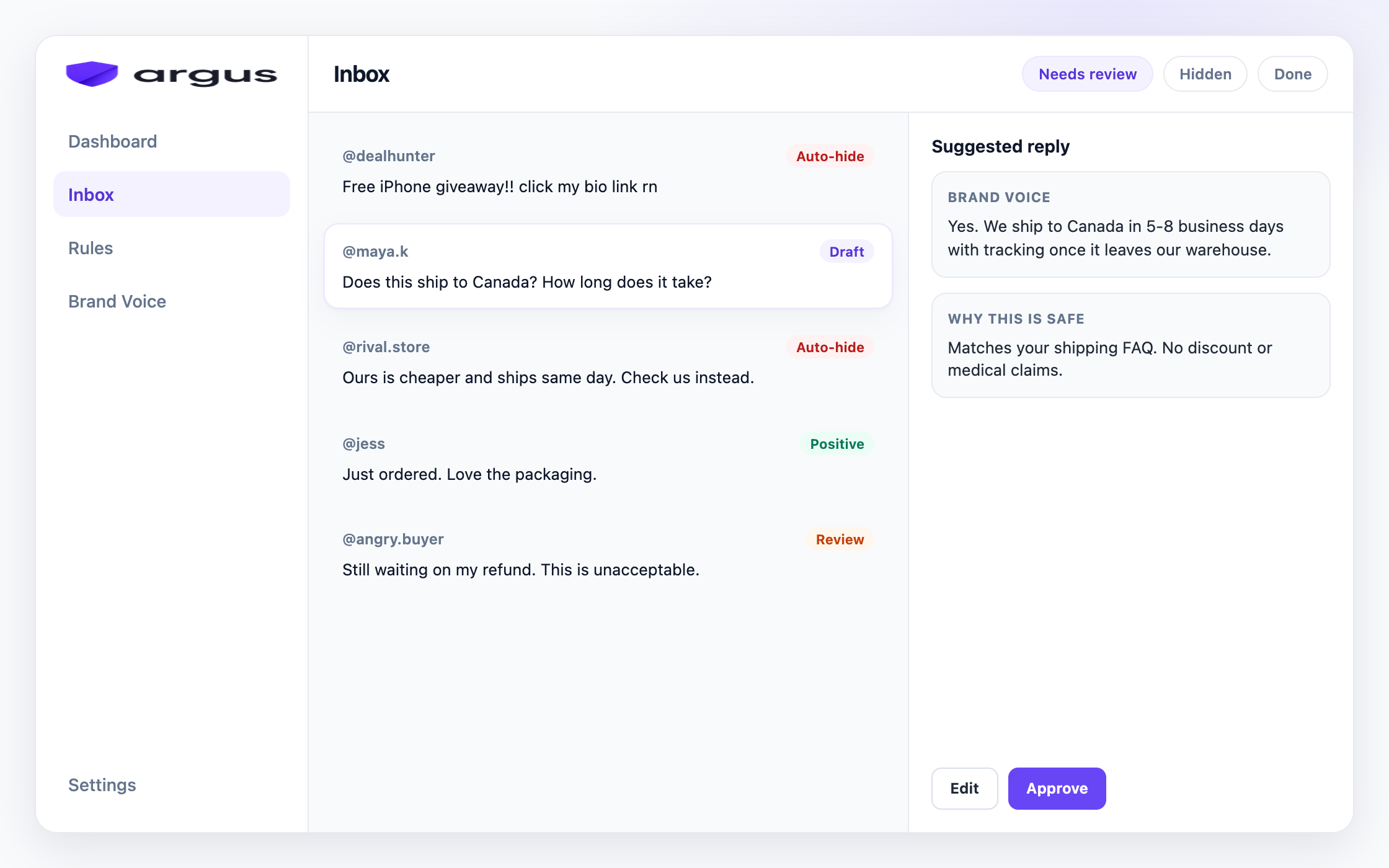
Argus classifies every comment under your Facebook and Instagram ads into categories like spam, scam, toxic content, competitor bait, buyer questions, complaints, and sensitive topics. Your Protection board sets one standing action per category (Auto-hide, Draft for review, Reply & send, Human review, or Do nothing), so rival webinar bait can Auto-hide around the clock while refund fights stay on Human review.
Curriculum and FAQ-style questions get grounded reply drafts written from your Brand Voice knowledge: your approved outline, access terms, and policies, with sources shown on every draft so you can verify before anything posts. Draft for review is the default. Safe Autopilot is a narrow opt-in for high-confidence FAQ matches only after those drafts prove they are boringly correct.
Argus covers public comments on Facebook and Instagram ads and posts. It hides from public view rather than deleting, it does not automate DMs or enrollment funnels, and it never invents curriculum claims. If your week is competitor cleanup plus the same fit questions on repeat, that is the job it was built for.
FAQ
Hide smear and policy abuse that is not a real student case. Real purchase issues need a human path. Arguing refunds under a cold ad trains new buyers to expect a fight.
Specific enough to reduce doubt: which modules cover the topic, who the course is for, and what access includes. Stay inside approved facts. Do not improvise bonuses or certificates you do not offer.
Yes when the draft is grounded in your published fit criteria and you review it first. It should never invent outcomes, guarantees, or module content that is not in your knowledge.
No. Public, accurate answers already move buyers. Argus does not automate DMs. If you move a conversation private, do that manually with a clear next step.
Ecommerce threads center shipping, sizing, and product stock. Course threads center curriculum fit, access terms, competitor webinar bait, and launch-week FAQ floods. Both need a human path for real disputes.
Hide the rival bait, answer curriculum questions, and keep real student issues with humans.