Why are skincare threads different from other ecommerce threads?
Selling skincare is selling trust in a jar. The buyer cannot test your serum through the screen, so they do the next best thing: they read the comments under your ads to see what happened to other people's skin. That makes your ad thread part of the product, closer to the ingredients list than to a billboard.
It also means the standard ecommerce moderation advice breaks in specific ways. Generic guides tell you to hide the negative stuff and answer the questions. For a skincare brand, some of the most damaging comments to hide are the ones you most need to keep (real reaction reports), and some of the most urgent to remove are not opinions at all (counterfeit links that can hurt someone).
This guide is the skincare version of comment moderation: the four comment types that decide your thread, the keep-vs-hide call for each, and the setup that runs it daily. For the general system behind it (classification, native Meta filters, weekly review), see our ecommerce comment moderation guide.
The threat map
What four comment types decide a skincare thread?
Reaction reports are not spam. “This gave me a rash”, “broke me out after two days”, “burning sensation on application”. These feel terrifying under a paid ad, and the instinct is to hide them instantly. Do not. A real reaction report is safety information and genuine customer feedback. Hiding it reads as suppression, screenshots travel, and other buyers with the same question learn nothing. Acknowledge publicly, move the details to a private channel, and have a human handle it.
Counterfeit and dupe links are a safety problem, not just a revenue one. Viral skincare products attract fake versions fast: “got mine for half price here” with a link to a counterfeit shop using your product photos. Someone who buys the fake can get a genuinely unsafe product. These get hidden on sight, the accounts get banned, and repeated offenders get reported. There is no keep-vs-hide debate on this one.
“Photoshopped” and “doesn't work” need a split call. Some of these are bad-faith bait from accounts that post the same accusation under every beauty ad. Some are genuine skeptics who got burned by another brand. Hide the obvious bait accounts. Answer the genuine ones once, calmly, with what you can prove (full ingredients list, return policy, real reviews), and let the thread judge.
Ingredient and skin-type questions are your pre-sale window. “Is it fragrance-free?”, “safe for sensitive skin?”, “does this work on acne-prone skin?”, “can I use it with retinol?” These are buyers at the decision point, asking in public where your answer works for everyone reading. Answer fast, answer from your verified product facts, and never guess.
The authenticity trap is real in beauty. Skincare buyers are trained skeptics. A thread with zero negative comments reads as censored, and a censored thread reads as a product that does not work. The goal is not a clean thread. It is a believable one: junk gone, questions answered, real criticism handled visibly.
The rule set
Should you keep, answer, escalate, or hide each skincare comment?
Hide on sight: counterfeit and dupe links, scam shops, phishing, competitor coupon bait, appearance-based hate, and body-shaming. No judgment calls here, and no replies. Hide, ban, move on.
Answer with your own facts: ingredient questions, skin-type compatibility, usage order, shipping and stock. The reply must come from your verified product knowledge (full ingredients list, usage instructions, policies), not from a support agent's memory and never from an AI's guess.
Always a human: reaction reports, allergy questions, pregnancy or medical-condition questions, refund demands, and anything that sounds like a legal or PR problem. No automation touches these, ever. This is also where your guardrail against medical claims lives: nobody, human or AI, promises results or diagnoses skin in a comment thread.
Leave alone: routine praise, texture questions answered further down the thread, and the usual emoji noise. Not every comment needs action.
Putting it together
What is the weekly workflow for a skincare thread?
Here is the weekly shape of a working skincare moderation setup, whether you run it manually or with a tool.
1
Audit your last week by type
Pull the comments under your active ads and sort them: counterfeit links, bait, ingredient questions, reaction reports, genuine criticism, noise. Most skincare brands find the same pattern: a handful of real issues hiding inside a lot of junk.
2
Write the keep-vs-hide policy
One page, four lists, from the section above. Everyone who touches the thread works from the same rules, so a nervous teammate never hides a real rash report at 11pm.
3
Load your product facts once
Full ingredients lists, usage instructions, who each product is for, shipping and returns. Every future answer, human or AI, draws from this same source instead of being re-typed from memory.
4
Set the reaction escalation path
Reaction reports and medical questions go to a named person with a response-time target, and the public reply plus private follow-up is tracked. This is the category where a missed comment becomes a screenshot.
5
Review the hidden pile weekly
Check what got hidden for false positives, especially genuine skeptics mistaken for bait. Unhide the mistakes. A believable thread is worth more than a spotless one.
Run this and the thread starts working like a second product page: counterfeits gone before they cost you, ingredient questions answered while the buyer is still warm, and real concerns handled like the safety issues they are.
How Argus fits
How does Argus run the skincare rule set around the clock?
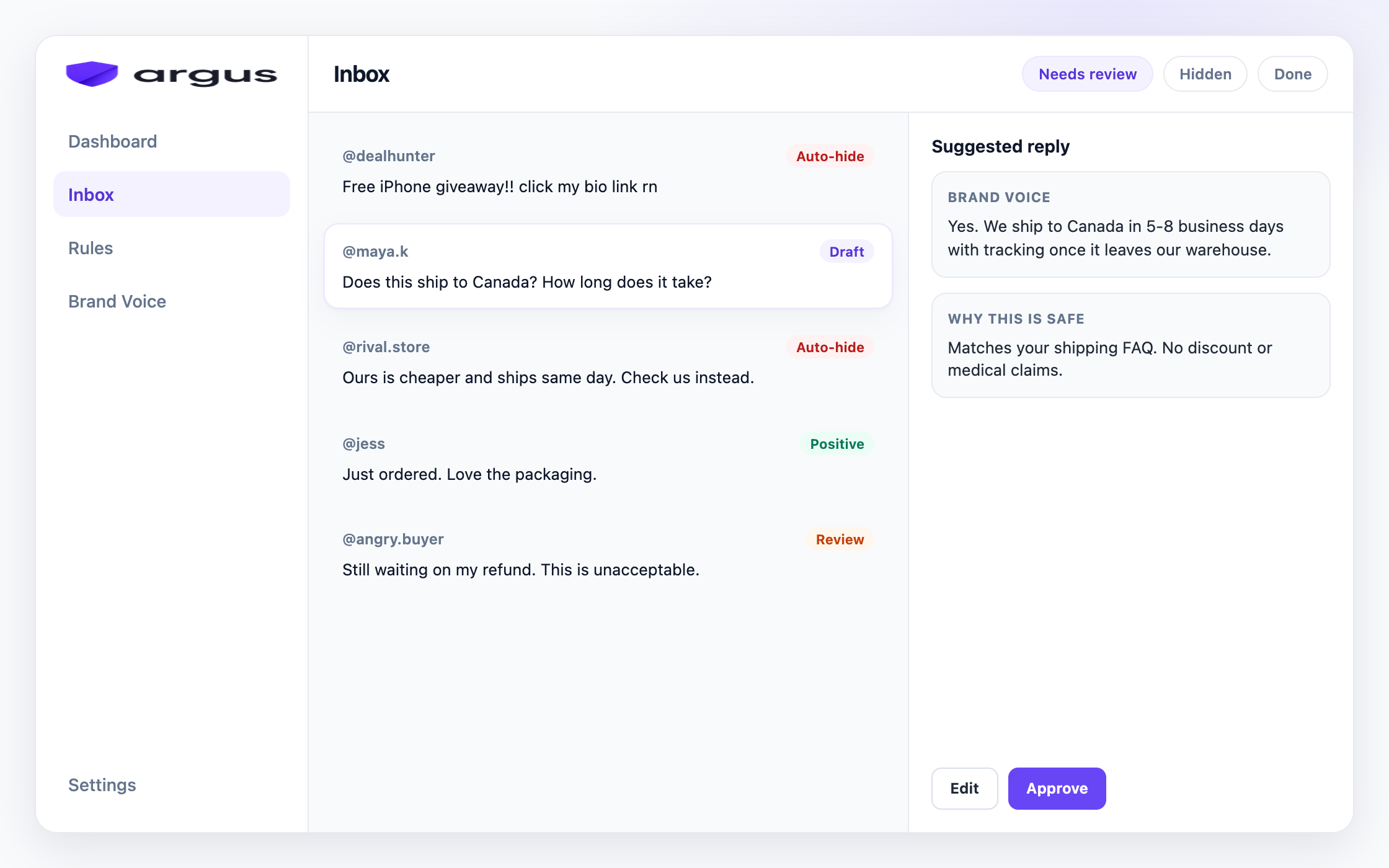
The skincare rule set is exactly the kind of thing that should run as a system instead of a daily judgment call. That is what Argus automates for Meta ads.
Argus runs this exact rule set. It classifies every comment under your Facebook and Instagram ads: spam, scam, toxic content, competitor bait, buyer questions, complaints, sensitive topics. Your Protection board sets one standing action per category, so counterfeit links and scam shops can hide automatically around the clock while reaction reports route straight to a human.
Ingredient and skin-type questions get grounded reply drafts written from your own Brand Voice knowledge: your ingredients lists, usage instructions, and policies, with the sources shown on every draft so you can verify before anything posts. Draft for review is the default. Safe Autopilot is a narrow opt-in for high-confidence FAQ-type questions only, and it never touches complaints, reactions, or anything medical by design.
Argus covers public comments on Facebook and Instagram ads and posts, and that is the whole scope. It hides comments from public view rather than deleting them, it does not automate DMs, and it never invents product claims. If your week is counterfeit whack-a-mole plus the same thirty ingredient questions on repeat, that is the job it was built for.
FAQ
What else should I know?
Should I hide negative comments on my skincare ads?
Only some of them. Hide counterfeit links, scams, competitor bait, and abuse on sight. Keep genuine criticism and real reaction reports visible, respond to them, and resolve them. A thread with zero negatives reads as censored, and censored reads as does-not-work.
What should I do about “this gave me a rash” comments?
Treat them as safety feedback, not spam. Acknowledge publicly, move details to a private channel, and have a human investigate. Never hide them silently and never let an automated system answer them.
Can AI answer “will this work for my skin type?”
Partially. An AI draft grounded in your own product facts can answer what is verifiable (ingredients, usage, who the product is formulated for). It should never diagnose skin, promise results, or give personalized medical advice. Those stay with humans.
How do I handle counterfeit product links in comments?
Hide them immediately, ban the accounts, and report repeat offenders. Counterfeit skincare is a customer-safety issue, not just lost revenue. Automated tools can catch most of these around the clock.
Won't hiding bad comments hurt my ad's credibility?
Hiding the wrong ones will. Buyers trust threads that look real: junk removed, questions answered, criticism handled openly. Hide junk and bait, keep and answer the rest.