1
Write the compliance blocklist once
List the disease, cure, treat, and prevent phrases you never want public under your ads, plus competitor names and affiliate patterns you see. Share the list with everyone who touches the thread.

Health-claim comments, “scam” pile-ons, and ingredient questions: the Meta ad-thread problems only nutraceutical brands get.
6 min read · Published Aug 7, 2026
The vertical
When someone comments “this cured my insomnia” under your melatonin ad, that is not a compliment you can leave alone. On a brand-controlled surface, customer language can look like an implied claim you are allowing to stand. Supplement brands live with that risk every day on Meta ads.
Generic ecommerce moderation advice is not enough here. Hiding every negative comment would bury real safety concerns. Answering every question with a friendly AI would invent claims you never approved. The working model is a keep-vs-hide split built for nutraceuticals: compliance first, then conversion.
This guide is the supplement version of comment moderation: the comment types that matter, the rule for each, and a daily setup that does not invent medical advice. For the general ecommerce system behind it, see our ecommerce comment moderation guide. For beauty-specific reaction and counterfeit patterns, see the skincare guide.
The threat map
Disease and cure claims are a compliance risk, not social proof. “Cured my ADHD”, “treats my anxiety”, “prevents disease”, “better than my prescription”. Even when a happy customer writes them, these comments can create regulatory exposure for the brand that leaves them public. Hide them on sight. Do not like them. Do not amplify them with a reply that agrees.
“Scam” and “does nothing” need a split call. Some are coordinated bait or copy-paste trolls that show up under every supplement launch. Some are real buyers who did not feel a result and deserve a calm, factual answer. Hide the obvious bait accounts. Answer genuine skepticism once with what you can prove: third-party testing, refund policy, usage instructions. Never promise results.
Ingredient, dosage, and certification questions are the sale. “Is this third-party tested?”, “safe with blood pressure meds?”, “vegan?”, “how many mg per serving?”, “any allergens?” These are high-intent buyers asking in public. Answer fast, and only from your approved product facts. Medication interaction questions always redirect to a healthcare professional.
Competitor and affiliate spam rides your ad spend. “Better version in my bio”, rival brand tags, coupon codes for someone else's store, “same formula cheaper”. These get hidden immediately. There is no debate worth having under a paid ad.
Adverse-reaction comments are safety work, not spam. “Made me nauseous”, “heart racing after two scoops”, “allergic reaction”. Treat these as potential safety feedback. Acknowledge publicly, move details to a private channel, and have a human follow up. Never hide them silently, and never let an automated reply diagnose or dismiss the experience.
The rule set
Hide on sight: disease/cure/treat/prevent claims about your product, competitor and affiliate spam, phishing links, and abuse. No replies that agree with an unapproved health claim.
Answer from approved facts only: ingredients, serving size, certifications, allergens, shipping, and returns. Every reply, human or drafted, must come from your verified product knowledge, not from memory and never from an AI guess.
Always a human: adverse reactions, medication interactions, pregnancy or medical-condition questions, refund disputes tied to health outcomes, and anything that sounds like a legal or PR problem. No automation posts here.
Leave alone: routine praise that stays inside structure/function language, emoji noise, and questions already answered further down the thread.
Putting it together
Here is the weekly shape of a working supplement moderation setup, whether you run it manually or with a tool.
List the disease, cure, treat, and prevent phrases you never want public under your ads, plus competitor names and affiliate patterns you see. Share the list with everyone who touches the thread.
Ingredients, serving sizes, certifications, allergen statements, usage instructions, and the exact structure/function language your team is allowed to use. This becomes the only source for public answers.
Adverse-reaction and medical questions go to a named person with a response-time target. The public acknowledgment and the private follow-up both get tracked.
Sort comments into disease claims, bait, ingredient questions, genuine skepticism, adverse reactions, and noise. Most brands find the same pattern: a few real issues hiding inside a lot of junk.
Check for false positives, especially buyers who said “this is not a scam” or asked a legitimate question that tripped a broad keyword. Unhide the mistakes. A believable thread beats a spotless one.
Run this and the thread starts working like a labeled product page: unapproved claims gone, ingredient questions answered while the buyer is warm, and real concerns handled like the safety issues they are.
How Argus fits
The supplement rule set should run as a system, not a nightly judgment call. That is what Argus automates for Meta ads.
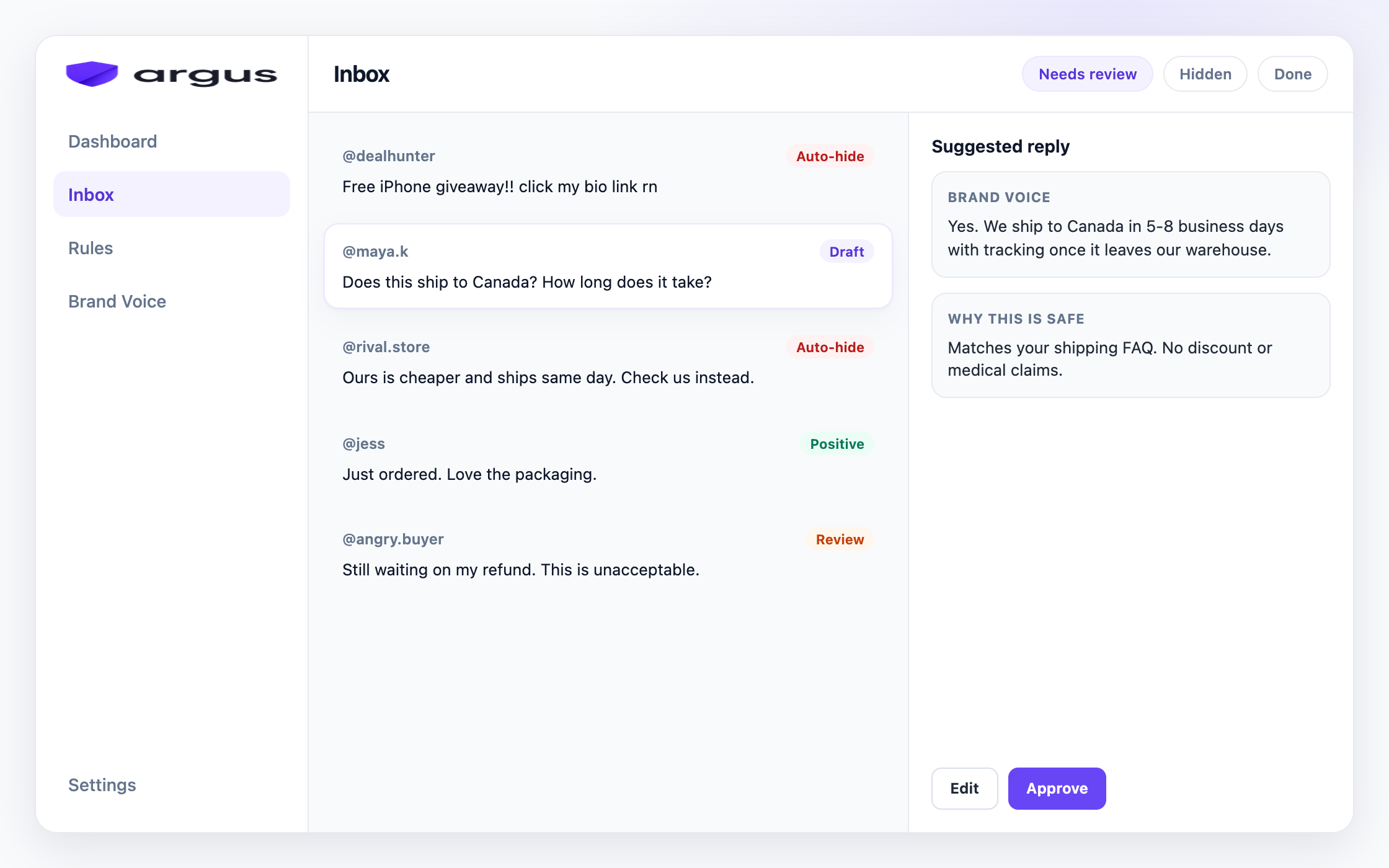
Argus classifies every comment under your Facebook and Instagram ads into categories like spam, scam, toxic content, competitor bait, buyer questions, complaints, and sensitive topics. Your Protection board sets one standing action per category (Auto-hide, Draft for review, Reply & send, Human review, or Do nothing), so affiliate spam and clear junk can Auto-hide around the clock while sensitive and medical-adjacent comments stay on Human review.
Ingredient and FAQ-style questions get grounded reply drafts written from your Brand Voice knowledge: your approved ingredients, certifications, and policies, with sources shown on every draft so you can verify before anything posts. Draft for review is the default. Safe Autopilot is a narrow opt-in for high-confidence FAQ matches only, and it never touches complaints, reactions, or medical questions by design.
Argus covers public comments on Facebook and Instagram ads and posts. It hides from public view rather than deleting, it does not automate DMs, and it never invents product or health claims. If your week is disease-claim cleanup plus the same ingredient questions on repeat, that is the job it was built for.
FAQ
Yes. Even when they are meant as praise, disease and cure claims under your ads create compliance risk. Hide them. Do not reply in a way that agrees with the claim.
Yes, when the draft is grounded in your approved product facts and you review it first. It should never invent benefits, diagnose conditions, or advise on medications. Those stay with humans, with a redirect to a healthcare professional when needed.
Hide obvious bait accounts. Answer genuine skepticism once with verifiable facts: testing, refund policy, how to use the product. Do not promise results, and do not get into a fight in the thread.
Skincare threads are dominated by reaction reports, counterfeit links, and “photoshopped” accusations. Supplement threads add FDA/FTC-style claim risk from customer language itself. Both need a human path for safety comments; supplements need an explicit hide rule for disease and cure claims.
No. Argus drafts from your own knowledge base and refuses unsupported or sensitive categories. Draft for review is the default, and Safe Autopilot does not cover medical or reaction comments.
Hide disease claims, answer from approved facts, and keep real safety concerns with humans.