1
Connect what owns the threads
Link the professional Instagram accounts and Facebook Pages behind your ads to whatever you use for review, whether that is Business Suite or a moderation tool.

What moderation means under an Instagram ad, why Reels reach makes threads wilder, which native tools actually help, and the operating model that scales.
6 min read · Published Aug 4, 2026
The basics
Instagram ad comment moderation is everything you do about the comments that collect under a paid Instagram placement: reading them, hiding the harmful ones from public view, and answering the questions that are close to a purchase. It applies to Feed, Reels, and Explore placements, where threads are public and sit next to the creative. Stories ads have no public comment threads, so there is nothing to moderate there.
Two boundaries keep this honest. First, this is about public ad comments, not Instagram DMs: DM automation is a different job with different tools, and it does not protect the thread every future viewer will read. Second, moderation here means hide, not delete. Hidden comments leave public view but stay reversible, and a well-moderated thread is more useful, not emptier.
Under one active Instagram ad you can find promo bot spam, “DM to claim” scams, competitor poaching, genuine complaints, and warm buyer questions, mixed together. Treating them as one bucket is how brands leave scams up for days or hide real customers by mistake.
Why it matters
Instagram puts social proof next to the offer, and Reels shows it to strangers. Prospects see the creative, the caption, and the first comments in one unit across Feed, Reels, and Explore, and they read those comments as reviews before they ever visit your profile.
Reels distribution raises the stakes. It pushes your ad to people who do not follow you, which is the point, but it means a large share of the thread comes from stranger accounts with no relationship to your brand. Some are first-touch buyers. Others are bots and bait accounts that found your ad through the same reach, and they arrive with every new wave of impressions.
The costs are the usual four, sharpened by that stranger traffic: promo spam that makes the brand look abandoned, scam and phishing bait that harvests your warmed audience, competitor poaching at the tap moment, and buyer questions (stock, sizing, shipping, restock dates) that convert when answered and evaporate when ignored. Meanwhile comments arrive around the clock and most teams check a few times a day, so overnight bait gets hours of paid distribution.
The landscape
Bot spam and promo bait: copy-paste crypto promos, fake verification offers, and engagement chains that make the thread look neglected.
Scam and phishing replies: fake giveaways and “DM to claim your prize” bait that make the brand look unsafe exactly where buyers are deciding.
Competitor coupon poaching: “buy elsewhere” comments redirecting intent at the moment someone is ready to tap.
Unanswered buyer questions: stock, sizing, and restock questions left open while ad spend keeps running.
Over-hiding fair criticism: the trust you lose when real complaints vanish and commenters post the screenshots elsewhere.
Current options
Manual hides in Ads Manager or the app: view the ad's comments and hide per comment, restrict repeat offenders in the app. Right at low volume; breaks at nights, weekends, and Reels-scale volume.
Hidden Words: Instagram's native auto-filter in the app settings: exact blocked words and phrases, plus a general potentially-offensive control. Good floor, but it matches strings, so buyers get caught and bait with no blockable phrase slips through.
Per-post comment controls: turn off commenting on a post, and ads built from it inherit the closed thread. Useful for a sensitive launch, but it silences buyers too, applies per creative, and there is no universal per-ad toggle.
AI comment tools: the newer specialist category: classify each comment, then hide, draft, or escalate per category. The quality difference between tools is mostly how well they understand meaning and how conservative their defaults are.
Better model
The model that holds up at spend is simple: classify first, then act. Every comment gets read for meaning before anything happens to it. Promo spam, scams, and obvious bait are hidden from public view automatically. Real buyer questions get a grounded reply drafted from your approved knowledge, not silence and not a guessed answer. Complaints, sensitive topics, and anything unclear stay with a human.
Two defaults make it safe. Actions are reversible: hide from public view, never delete, so a wrong call is one click to fix. And automation is opt-in per category: you decide which comment types act automatically and which always wait for a person. The teams that get burned by automation are usually running broad rules with no classification step in front of them.
Workflow
A conservative first week works whether you stay on native tools or add a specialist. It looks like this.
Link the professional Instagram accounts and Facebook Pages behind your ads to whatever you use for review, whether that is Business Suite or a moderation tool.
One line per category: clear spam gets hidden, buyer questions get answered, complaints get a person. If a rule does not fit in one line, it is not ready.
Shipping, sizing, restock dates, returns: the five to ten answers your buyers ask for daily, in your voice.
Fifteen minutes: check what got hidden for false positives, answer what needs answering, tighten one rule. Consistency beats intensity.
How Argus fits
If classify-then-act sounds right but the daily review sounds like another job, that is exactly the gap Argus fills.
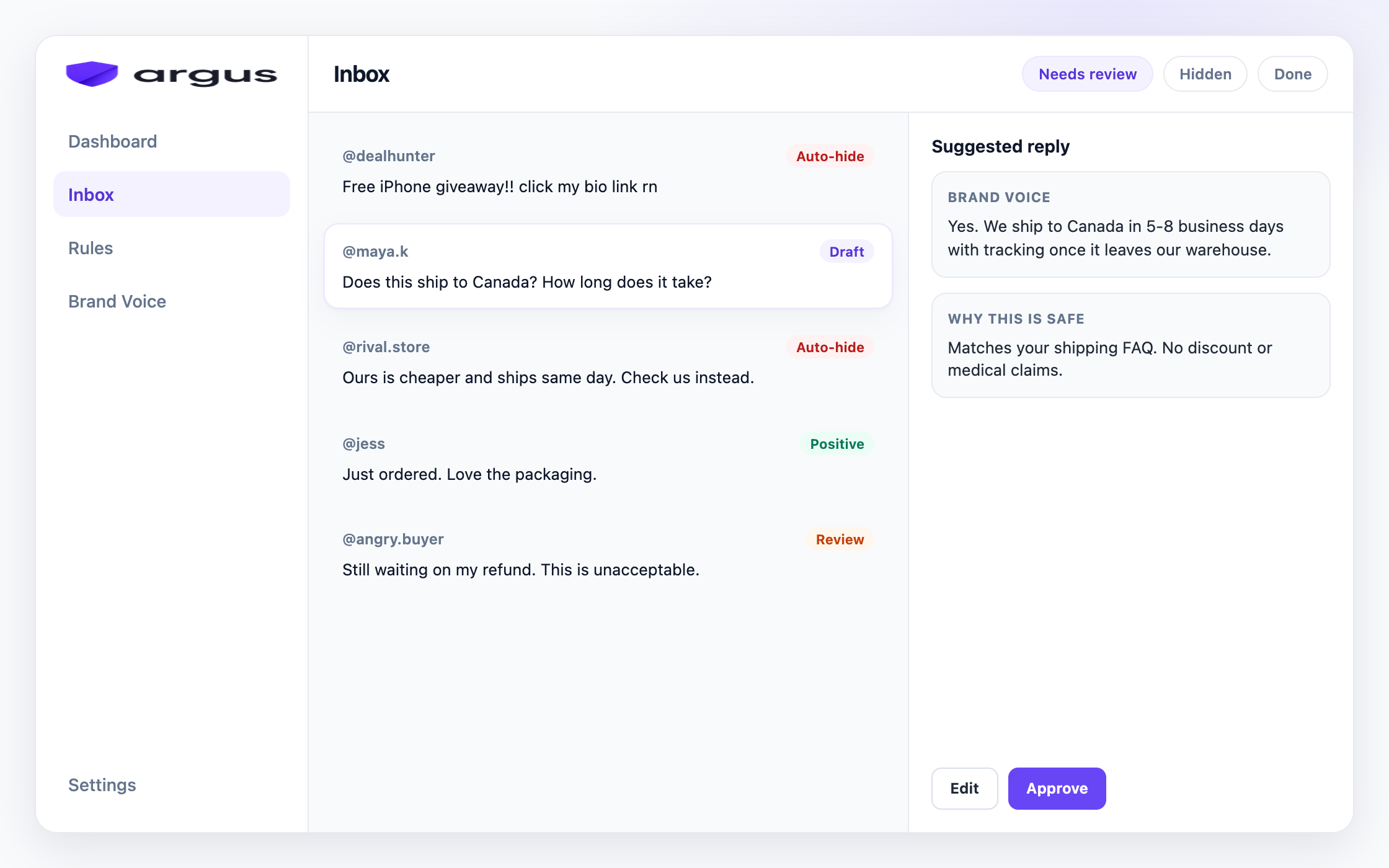
Argus reads every comment under your Instagram and Facebook ads and sorts it into categories like spam, scam, toxic content, competitor bait, buyer questions, and complaints. On the Protection board you choose the action per category: Auto-hide, Draft for review, Reply & send, Human review, or Do nothing. Most teams start with clear junk on Auto-hide and everything else in review, then widen as the rules prove themselves.
Buyer questions get drafts grounded in your Brand Voice knowledge, so answers are fast without being invented. Draft for review is the default, and Safe Autopilot, which sends without approval, stays a narrow opt-in for proven FAQ matches. Every action is a hide from public view, never a delete.
Honest scope note: Argus covers public Instagram and Facebook ad comments. It does not automate Instagram DMs, it does not moderate TikTok or review sites, and it is not a publishing suite.
FAQ
It is the work of reviewing comments under Instagram ads, hiding harmful or low-quality comments from public view, and answering real buyer questions while the ad is still spending.
Only partially. You can turn off commenting on a regular Instagram post, which also affects ads built from that post, and Meta is testing a comment toggle in Ads Manager with some advertisers. There is no universal off switch for ad comments. Most teams hide harmful comments instead so buyer questions can still come in.
Hidden Words helps with exact blocked strings. It does not understand buyer questions, catch competitor bait that avoids your keywords, or draft grounded replies. Many teams still need a workflow that classifies each comment, then chooses Auto-hide, Draft for review, Reply & send, or Human review.
No. Stories ads do not carry public comment threads. Comment moderation on Instagram centers on Feed, Reels, and Explore placements, where comments sit beside the creative.
No. Clear spam, scams, and bait can be hidden from the public thread. Fair complaints and unclear cases should stay in Human review so you do not bury real customer issues.
No. Argus hides comments from public view so moderation stays reversible. Delete is not part of the current product.
No. Argus is Meta-first for public Instagram and Facebook ad comments. It does not automate Instagram DMs or moderate TikTok, YouTube, or review sites.
Create an account, set Protection rules, and connect Meta when you are ready.