1
Acknowledge publicly in one line
Reply under the comment itself: sorry this happened, we want to fix it, here is what happens next. One line, no excuses, no policy quotes. The public reply is for the readers, not just the commenter.

Complaints are customers, abuse is not. A respond-first framework for the first, a hide-and-ban routine for the second, and the line between them.
10 min read · Published Aug 4, 2026
The problem
Negative comments come in two species, and the response that works for one makes the other worse. The first species is the legitimate complaint: late shipping, a broken item, a refund stuck in support limbo. The person writing it bought from you or almost did, and they want to be fixed, not fought. The second species is toxic abuse: slurs, profanity, personal attacks on your team or other commenters, and bait from accounts with no purchase intent at all.
The instinct to hide everything negative is understandable, and it backfires. Commenters notice when their complaint disappears. Screenshot culture is real: a hidden customer posts the before-and-after in a group, and now the story is not your shipping delay, it is that you bury critics. Advertisers who have lived through it describe the cover-up as worse than the complaint.
Ignoring complaints has the opposite cost. Every unanswered negative comment sits under the ad telling the next hundred viewers that nobody is home. Future buyers do not read your thread the way you do. They scan for how the brand behaves when something goes wrong, because that is the experience they are buying insurance against. Advertisers who fix their response time usually describe the change in terms of trust, not metrics: the thread starts working for the ad instead of against it.
So the job is not hide the negative comments. It is triage: separate the person who needs help from the person who needs removing, then apply the right response fast. Below are the three methods teams actually use, and the decision frame that keeps the calls consistent.
Method 1
For legitimate complaints, the highest-leverage move is the public reply. Not a defense, not a form letter: a fast, human acknowledgment that shows every future reader how you treat people when something goes wrong.
Reply under the comment itself: sorry this happened, we want to fix it, here is what happens next. One line, no excuses, no policy quotes. The public reply is for the readers, not just the commenter.
Send them to your support channel or DM for order details. Never ask for personal information in the public thread, and do not try to resolve the whole case in public replies.
When the refund lands or the replacement ships, add one short public follow-up on the original thread. Most teams skip this, and it is the highest-trust move available: the thread now shows a complaint with an ending.
No arguing about fault, no correcting the customer's tone, no stacked replies. If the commenter wants a fight, your one calm line still stands for everyone who reads it later.
This is slower per comment than hiding, and that is the point. A legitimate complaint is a retention chance and a public demo at the same time. The cost is judgment at volume: at a handful of comments a day it is easy, and at scale it is the first thing that slips overnight and on weekends.
Response examples
These are operating templates, not scripts to paste blindly. Replace the general next step with the support path and facts your team can actually honor.
Delayed order: Public reply: acknowledge the delay and state the next step without guessing at a delivery date. Move the order number, address, and tracking details to support or a private message. Keep the complaint visible, then add a short public update when the case is resolved.
Damaged item: Public reply: apologize for the condition and offer the real replacement or refund path. Move photos, order details, and account information to a private channel. Do not hide the original comment unless it turns into abuse; a visible resolution is stronger than a spotless thread.
Price objection: Public reply: answer with a verified product difference, warranty, material, or offer detail if one is relevant. Never invent a discount or argue that the buyer is wrong. Leave fair criticism visible, and move private only when the person has an account-specific question.
Abusive bait: Do not draft a customer-service reply for slurs, threats, or repeated personal attacks. Hide the comment, ban the account when the behavior repeats, and report clear violations. A blunt product opinion is not abusive bait and should stay visible.
When the facts are repetitive but the wording changes, a grounded draft can save the first pass. See how AI comment replies for Meta ads stay tied to approved brand knowledge before a person posts.
Method 2
Abuse is different. The commenter is not a customer in trouble; they are there to poison the thread. Answer that publicly and you feed it. The right response is removal from public view, and for repeat offenders, removal of the account's access.
Hate speech and slurs, profanity aimed at people, personal attacks on your team or other commenters, threats, and obvious bait from accounts with no purchase intent. Frustration about your product is not abuse; anger about a real order is a complaint with rough edges.
In Ads Manager, open the ad and view its comments, or work from your Page inbox. Hover the comment and choose Hide. Hidden comments leave public view but stay visible to the commenter and their friends, which avoids the escalation a delete often triggers.
From the comment or your Page's banned-users settings, ban accounts that come back. Hiding treats comments; banning treats accounts. Persistent trolls require the second.
Use Meta's report flow for content that violates community standards. It is slow and inconsistent, but reports are how repeat-offender accounts eventually lose the platform, not just your thread.
The failure mode here is the opposite of method one: teams get comfortable and start hiding complaints that merely sting. If hiding is your only move, every negative comment starts looking like abuse. That is how brands end up in a screenshots thread.
Method 3
Manual hide-and-ban works until spend scales. For paid threads, Meta's Page keyword and profanity filters carry the routine load. Moderation Assist is for organic Page comments, not ad comments.
Use the Page setting for blocking comments with profanity as a narrow first layer. Treat it as a backstop for explicit language, not a decision about whether criticism is fair.
Add slurs, explicit profanity, and attack phrases you have actually received. Keep the list to words that are almost never innocent.
Do not blocklist words like refund, disappointed, or late. Frustrated customers use exactly these words, and hiding them automatically is over-hiding on autopilot.
Unhide false positives and note what the filters keep catching. A filter you never review is quietly making reputation decisions for you.
Page filters catch profanity and known strings, not meaning. A furious customer typing about a delayed order can trip the same keyword rule as a troll. Use these filters for the clearly toxic layer, and keep humans on the complaints.
Decision guide
Reply when it is a legitimate complaint: a real order, a real problem, a person who wants to be fixed. Fast public acknowledgment, private resolution, visible follow-up. This is most negative comments under most ads.
Hide when it is abuse: hate, profanity, personal attacks, threats, and bait from accounts that were never going to buy. Hiding removes the poison without feeding it, and you never owe the thread a debate about the call.
Leave it when it is fair criticism you dislike: a bad review under the ad, a comparison where you lose, a complaint you already answered. A thread with some criticism and good answers reads as honest. A thread with zero criticism reads as curated, and buyers notice that too.
Ban when abuse repeats: the same account returning, rotating troll accounts, coordinated pile-ons. Banning is an account-level decision, so save it for patterns, not single bad days.
Reality check
The framework is simple on paper. The same four frustrations come up whenever advertisers describe how it goes in practice.
“We hid a complaint and got called out.” The most common over-hiding story. The fix is not better hiding; it is a narrower definition of abuse, a weekly hidden-comments review, and a fast unhide-plus-reply when you get one wrong.
“Our reply made it worse.” Almost always a stacked-reply or defensive-tone problem. One acknowledgment, then move it private. The thread is read by future buyers; it is not a case you win against the commenter.
“The troll keeps coming back.” Hiding treats comments, not accounts. Ban repeat abusers, report clear policy violations, and add recurring attack phrases to a narrow Page keyword list. Do not rely on organic-only Moderation Assist to protect paid threads.
“Unanswered complaints killed our click-through.” Advertiser sentiment, not a controlled study, but it comes up constantly: teams describe threads full of unanswered complaints as ads that quietly stopped pulling, and describe the fix as trust returning rather than a metric jumping. The safe version is simple: future buyers read your thread, and silence is a loud answer.
How Argus fits
The hard part was never knowing what to do. It is telling a complaint from abuse, comment after comment, without getting the call wrong in public.
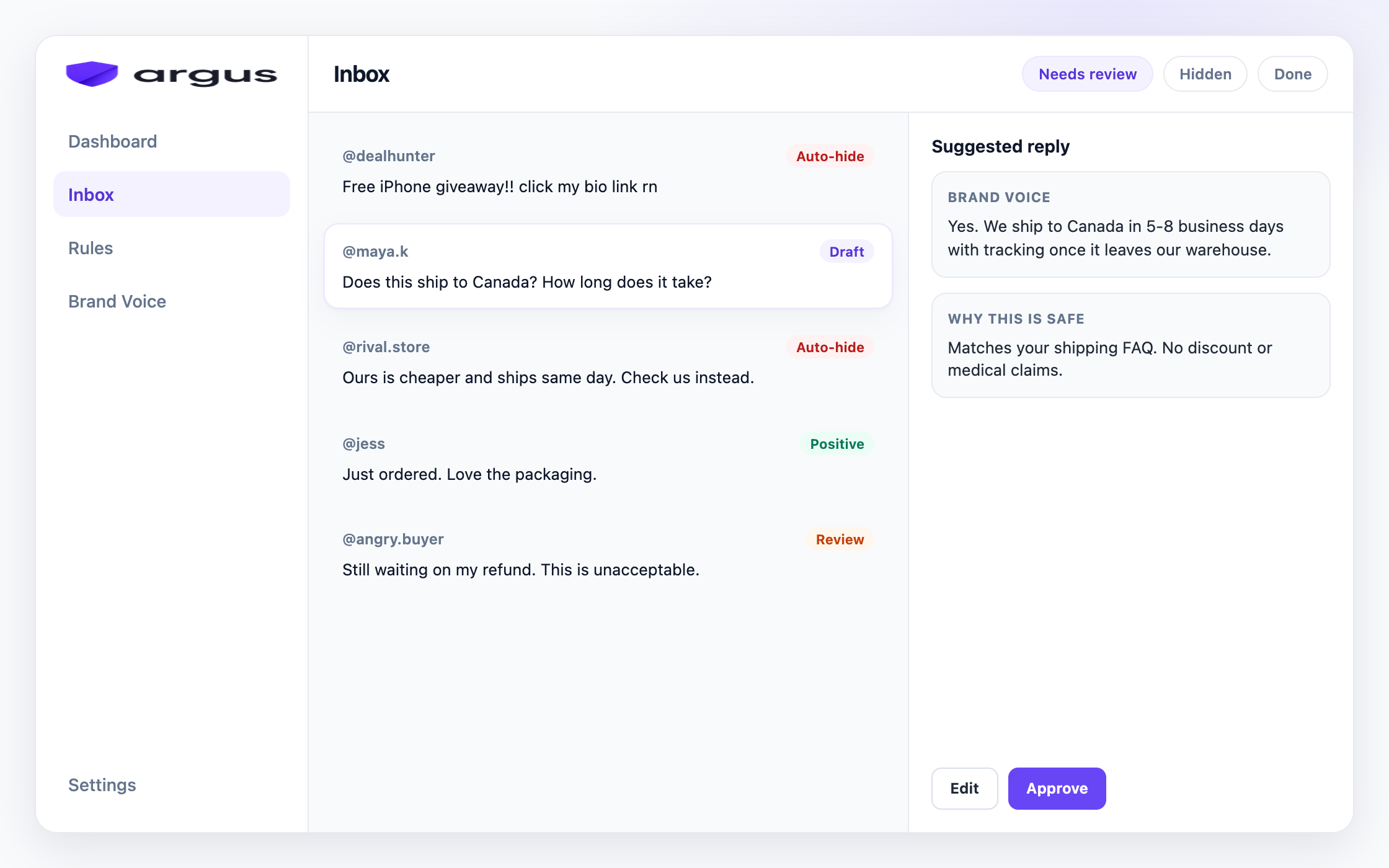
For connected Facebook and Instagram ad threads, Argus classifies incoming comments as complaints, toxic content, spam, scams, competitor bait, or buyer questions. On the Protection board you choose what happens to each kind. Complaints can route to Draft for review, so a grounded reply in your Brand Voice waits for approval, or to Human review when you want a person on every one. Toxic comments can route to Auto-hide.
That maps to the framework above without the willpower tax. Legitimate complaints get a grounded draft from your support knowledge. Abuse can leave public view automatically. Hidden comments are never deleted, so a wrong call stays reversible: unhide, answer, move on. Draft for review is the default, and Safe Autopilot, which replies without approval, stays a narrow opt-in.
Argus works on public Facebook and Instagram ad comments only. It is not a publishing suite, it does not automate Instagram DMs, and it will not make an angry customer happy. It helps the customer get a prompt, reviewed answer instead of silence while the troll gets no public attention.
FAQ
Hide abuse: hate, profanity, personal attacks, and bait. Do not hide legitimate complaints or fair criticism. Hidden comments leave public view but stay visible to the commenter and their friends, so hidden complainers usually notice, and screenshots travel. Answer complaints instead.
Reply publicly, once, to every legitimate complaint: a one-line acknowledgment plus a path to resolution, then move the details to a private channel. You do not need to win the thread. You need every future reader to see that you show up.
Separate legitimate complaints from abuse. Acknowledge real customer problems publicly, move personal details to a private support channel, and follow up visibly after resolution. Hide hate, threats, personal attacks, and obvious bait. Leave fair criticism visible.
Use one calm public reply: acknowledge the problem, state the next step, and give the customer a private support path for order details. Do not argue or promise an outcome you cannot verify. Add a short public follow-up when the issue is resolved.
A hidden comment leaves public view but remains visible to the commenter and their friends, and you can unhide it. A deleted comment is gone, the commenter usually notices, and deletion tends to escalate. For negative comments, prefer hide in almost every case and save delete for clear policy violations.
Partially. Page profanity and keyword filters cover ad comments and catch explicit language or known strings such as slurs. They do not read meaning, so a broad keyword list can hide frustrated customers too. Keep it narrow and review hidden comments weekly. Moderation Assist is for organic Page comments, not ads.
No. Argus hides comments from public view so every action stays reversible. Complaints route to Draft for review or Human review for an answer; only comments in the toxic category route to Auto-hide, and only when you choose that action. Delete is not part of the product.
Classify every comment, draft grounded replies for complaints, and auto-hide the toxic layer.